|
Questions & Answers
What is radon?
What is 4.0 pCi/L?
What does radon do?
Is Radon's connection with Lung
Cancer scientifically valid?
Are radon levels below 4 pCi/l safe?
Should I be concerned about Granite Countertops?
What radon action level do other countries use?
Does radon cause other health problems or symptoms?
How many homes in my area have elevated radon?
Should I do another radon test?
Can I do my own radon test?
Are electronic radon monitors more accurate than passive testers?
What is a long-term radon test?
Should I test radon in water?
Does a vacant house have higher radon levels?
Can a home seller beat a radon test (cause it to pass)?
Does it make a difference if my house is drafty or very airtight?
Can slab on grade or walk out basements have high levels?
Why are previous radon tests so different?
If I have high radon levels should I move out - open windows - not worry?
How does radon get into my house?
Can radon be reduced by sealing cracks and slab openings?
How does a radon mitigation system work?
Must the fan be outside or in the attic & vented above the roof line?
How big are the radon pipes?
How much do mitigation systems cost?
Can a Homeowner install a radon mitigation system?
How is radon mitigation handled if I'm buying or selling a home?
How is a mitigation system tested?
How low will radon levels be after installing a radon system?
What fan should be used for a radon mitigation system installation?
How much will it cost to run the radon fan?
Do the radon fans have to run continuously?
Can you reduce loud radon fan vibration or airflow pipe noise?
How do I know the radon system is working?
Can a high efficiency or HEPA filter reduce radon levels?
Does a radon system reduce basement humidity or mold?
What is Thoron?
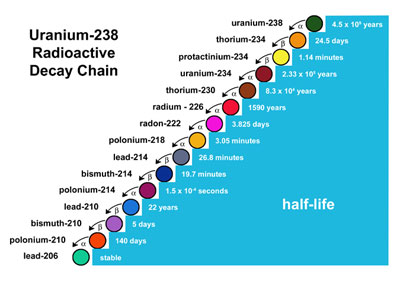
Answers What is radon? Radon originates
from Uranium 238, a radioactive element. Almost anywhere in
the world you can find some radioactive Uranium 238 in the soil.
Pennsylvania in particular has a lot of it. Radioactive simply
means that the element or atom occasionally loses part of itself and
changes into a different element. During this radioactive decay
the element releases energy and causes varying amounts
of damage to whatever surrounds it. The average amount of time it
takes before half of the element has decayed or changed is know as the
elements half life. Uranium 238 has a 4.5 billion year half life.
See the half lives listed below. Half of the uranium 238 is gone
because the earth is also about 4.5 billion years old, but there's still
plenty left in the soil. The next element, Thorium 234 has only 24
days before half of it is gone.
What is 4.0 pCi/L? Radioactivity in
the United States is
measured in units of Curies which is equal to the decay rate of a gram
of Radium. Curie comes from Madame Curie, the renown scientist who
determined the decay rate of radium in the 1920's. One pCi/L is one
trillionth of a curie of activity in a liter of air. The US EPA
recommends that the level of radon in a home be reduced below 4.0 pCi/L.
In Europe and Canada they use Becquerel's per cubic meter (Bq/m3).
Four pCi/L is about equal to 150 Bq/m3. What does radon do? Radon floating in
the air of our homes decays back into solid particles that are
charged (reactive). These short-lived radon decay products can become lodged in
our lungs or enter our lungs attached to dust particles. The decay of
these solid particles damages our lung tissue and if there is adequate
exposure it increases the chances of protracting Lung Cancer. Is Radon's connection with Lung Cancer scientifically valid? Every scientific
group that has carefully looked at the available data has agreed that
there is a connection between radon exposure and lung cancer. Radon has
a Class A carcinogen rating because there is so much human data, animal
studies and a sound explanation of how it takes place.
Are radon levels below 4 pCi/l safe? Other environmental
exposures are regulated to reduce the lifetime risk of cancer to one in
100,000. The EPA lists Radon risk exposure to 4.0 pCi/L for a lifetime
(18 hours per day) to
cause 7 additional lung cancers in a thousand non-smokers or 62
additional lung cancers in 1000 smokers. The risk is considered linear
which means even 2 pCi/L for a lifetime would cause 3 additional cancers
in a 1000 non-smokers. Fortunately, most of us are not exposed for a lifetime;
however, we would get a similar risk if we were exposed to four times as
much for a quarter of a lifetime or 16 pCi/L in your bedroom for 17
years. Should I be concerned about Granite Countertops? In a paper on measuring
radon from granite countertops, presented at the 2008 International Radon
Conference, measurements indicated it would only be in rare
cases that radon would be significantly elevated in a home from granite
tile or granite countertops.
What radon action level do other countries use? Canada recently
lowered it's action level to 200 Bq/m3 (equal to 5.4 pCi/L).
Presently Australia, Ireland, Sweden and the UK also use 200 Bq/m3
as the recommended action level. It is highly unlikely that
the US EPA will raise the recommended action level from it's present 4.0
pCi/l level (150Bq/m3) to 5.4 pCi/L. Does radon cause other health problems or symptoms? Exposure to
elevated radon levels has been consistently shown to increase the risk
of lung cancer. Scientific studies have not found any other
cancers that were induced by radon exposure. You cannot smell, taste or
feel radon in the air. How many homes in my area have elevated radon? Please see our individual maps
of every county in Pennsylvania with each zip code color coded
by percentage of homes with radon levels above the guideline: Should I do another radon test? If only one radon
test was done in your home it is generally recommended to make a second
measurement before deciding on mitigation. Radon tests are easy and
inexpensive. You can purchase test kits from several suppliers.
We recommend: Accustar Labs. Can I do my own radon test? It is not difficult
to do your own radon test. You can always test
your own home even if it is involved in a real estate transaction. A
new buyer, however, may only feel comfortable with a radon test done by
a certified independent radon tester. Are electronic radon monitors more accurate than passive testers? Electronic radon
monitors that give hour by hour radon results can be more accurate than passive test kits such as charcoal
detectors or E-Perms. All radon test kits and monitors used in Pennsylvania must
pass proficiency tests. Electronic radon monitors offer the advantage
of measuring the radon levels every hour, which can indicate unusual
radon patterns or possible radon test tampering. The inexpensive
Pro-Series 3 radon monitor does not give hour by hour radon measurements
but does provide a continuous long term average. This monitor is
new and has not been officially listed by the EPA or any state or
national radon certification programs. What is a long-term radon test? Short-term radon
tests are generally 2 to 7 days in length. Short-term tests must be
made with closed house conditions. A long-term radon test is three
months to one year in length. Long-term tests do not require closed
house conditions. If radon measurements during a real estate
transaction are questionable, a long-term test is sometimes performed
with money left in an escrow account to pay for a radon mitigation
system if the long-term test results are above the 4.0 pCi/L guideline. Should I test radon in water? The EPA states in
the Home Buyers and Sellers guide to radon: "If you
have tested the air in your home and found a radon problem, and your
water comes from a well, have the water tested." Radon in water needs
to be in the thousands to be a significant risk. One study indicated
that about 1 in 20 wells in Pennsylvania will have radon levels of 3000
pCi/l or higher. For more information refer to the radon in water
information page at:
Radon in Water info page Does a vacant house have higher radon levels? The upper floors of
a vacant house will likely have higher radon levels than a similar
occupied house if a normal occupied temperature is maintained. The
basement ventilation level of a vacant house, however, is not likely to
be significantly different than an occupied house and therefore is likely to be a similar radon level. Note that radon does not build up
to higher levels the longer a home is vacant because of normal natural
ventilation. Can a home seller beat a radon test (cause it to pass)? Radon levels will
change when you open a window especially if the window is in the same
area as the test kit. In general however the window or multiple
windows have to be wide open in the test area to make a big change (cut
radon levels in half). Opening windows can bring marginal radon
levels below the guideline. Opening windows on floors above the area being tested can
cause the radon levels to go either higher or lower. Moving the
radon detector to a low radon area will obviously also change the
results to the new location level but many testers will minimize this
possibility with tamper resistant features. Whether you believe radon is over-hyped
or not, the EPA
risk table graphically illustrates that the exposure risk is
very serious and lung cancer is the most deadly cancer. Does it make a difference if my house is drafty or very airtight? Radon levels are
primarily due to three factors, location, location and location.
How much radon is in the ground and how easily can gas move through the
soil. The
type of house and its air tightness is less important. Can slab on grade or walk out basements have high levels? People
assume that slab on grade or walk out basements will have low radon
levels. Unless the windows or doors are left open radon from the
soil can just as easily enter these types of buildings. All that
is needed is radon in the soil, some openings through the slab and the
building warmer inside than outside (rising inside warm air draws
radon into the building). Why are previous radon tests so different? Some difference is
expected because radon levels fluctuate due to weather and house
conditions. It is not un-common for radon levels to be twice as high or
one half of previous measurements. Upstairs measurements in particular
can be significantly different in heating versus cooling seasons.
Basement measurements tend to be more consistent in different seasons.
A basement measurement that is ten times higher or one tenth of a previous
measurement would be unusual. If I have high radon levels should I: move out - open windows - not worry? Radon exposure is
based on a combination of how long you are exposed and the radon level.
In general it is not necessary to ventilate a house unless the
mitigation system cannot be installed in the next few weeks and the radon levels
are very high (greater than a hundred pCi/l). The best ventilation is
leaving a basement window continuously open and/or a bedroom window open at night. How does radon get into my house? Radon is typically
drawn into a house from the soil directly under the home because the
lower level of the house is negative in pressure as compared to the
soil. The negative pressure is mostly caused by the air in the home
being warmer than the outside and escaping out the top of the house.
Many air-handling systems in homes also induce a negative pressure in
the lowest level. This negative pressure draws radon laden soil gas
into the house via cracks and openings in the lower level concrete slab
or from a dirt floor crawl space. Can radon be reduced by sealing cracks and slab openings? Reducing the radon
levels in a home by sealing cracks or a sump pit has not proven to be very effective.
This is partially due to the radon levels in the soil building up to a higher
concentration when the openings are sealed so that less soil
air comes in but it comes in at a higher radon concentration. Sealing
is still a necessary component of sub-slab depressurization
radon mitigation systems. How does a radon mitigation system work? The most common
radon system is a sub-slab depressurization system. A fan, located
in an attic or outside the building, is used to draw air out from under a basement,
crawl space or slab on grade concrete slab. If done properly, the
entire area directly below the slab becomes negative in pressure as compared to
the air above the slab. This causes the normal airflow out of the soil
to reverse and flow into the soil, which effectively stops all
infiltration of radon laden soil gas. The sub-slab depressurization
system needs to create this sub-slab negative pressure under all slabs
that are contributing a significant amount of radon into the building.
Must the fan be outside or in the attic & vented above the roof line? Active soil depressurization (ASD)
must be vent above the roof line because the radon levels in the exhaust
are often thousands of pCi/L. Sometimes it is possible to route
piping from the basement up through a closet(s) to the house attic or
through the garage to the garage attic. The fan can be installed
in the attic and the exhaust would be routed above the roof by using a
plumbing flashing through the shingles. We use downspout piping on
the outside to minimize system appearance. The radon fan cannot be installed in the basement. The fan
must be outside or in the attic. How big are the radon vent pipes? The radon vent pipes are typically
3" or 4" inside diameter PVC piping. Four inch pipe can easily
move 150 cfm of air while three inch pipe can move 80 cfm. Many
house can be fixed using only three inch pipes but four inch allows a
margin of safety if more air needs to be moved through the system.
Sometimes smaller 2" or even 1.5" pipes are used to draw small amounts
of air out from under a membrane or a block wall. How much does a mitigation system cost? Simple radon
mitigation systems start at a cost of $850 plus the cost of the post mitigation test,
which is required in Pennsylvania. A new home with the radon piping
pre-installed by the builder will be a couple of hundred dollars less. If
the home requires extra sealing, extra suction holes, treatment of a
crawl space or slab on grade the cost can be twice as much as a simple
system ($1600). Can a Homeowner install a radon mitigation system? In Pennsylvania the
following items are required by state law: A
certified mitigation individual must either visit the home, typically as part of
the estimate, or must be present at the initiation of the mitigation
installation. A mitigation certified individual must inspect the
completed system if the original mitigation system designed by the
certified individual is changed. At least every fifth unchanged
mitigation job
in PA must be inspected by a mitigation certified individual. How is radon mitigation handled if I'm buying or selling a home? Normally the buyer
is responsible for having the home tested for radon. If the levels are
above the guideline either the buyer or the seller is responsible for
getting one or more radon estimates. Typically the seller pays for the
radon mitigation. Sometimes the agreement of sale specifies the seller
is responsible for a partial amount of the cost. After the system is
installed, the seller is often responsible for paying for the post
mitigation radon test unless it is defined differently in the agreement
of sale. How is a mitigation system tested? The PA DEP and the EPA RMS requires a
post mitigation radon test be completed within 30 days after the
mitigation system is activated. It is advisable to have an
independent certified tester perform the test for all real estate
transactions How low will radon levels be after installing a radon system? 85% of our post
mitigation test results are less than 2.0 pCi/l. The remaining systems
are between 2.0 and 3.9 pCi/l. What fan should be used for a radon mitigation system installation? Radon fans are often
oversized for the requirements. Homes that ahve a gravel
base under the slab can often use a very efficient 20 watt fan
especially if the slab cracks can be sealed. Homes that do
not have a gravel base under the slab often require a 60 watt fan.
120 watt fans are used with homes where the mitigation systems will
require high airflow or stronger vacuum to overcome the resistance of
pulling air through compacted soil under the slab. If a mitigation
system needs to move a lot of air the size of the pipe is more important
than the strength of the fan. 3" pipe moves up to 80 cfm while 4"
pipe moves up to 150 cfm.
How much will it cost to run the radon fan? We use the most
energy efficient fan sold that will effectively reduce the radon
levels. Two thirds of our mitigation systems use a 60-watt fan that
costs about $70/year to operate. One third of our systems use an
20-watt
fan that costs about $20/year to operate. This super-efficient 20-watt fan
is very quiet and will save $500 or more in electrical cost over ten years. Do the radon fans have to run continuously? If you turn a radon
fan off, the radon levels will return to the pre-mitigation levels within
a few hours. In addition, ground moisture will begin to enter the
bearings and motor, causing a pre-mature failure of the fan so it is
best to keep the fan running even if you go on an extended vacation. Can you reduce loud radon fan vibration or airflow pipe noise? The systems noise is
probably due to fan vibration transfer back though building materials
rather than the actual fan noise. If the fan is very noisy it
could be the fan bearings have gone bad. The fan may also be
oversized for the system requirements and a more energy efficient and
quieter fan can be installed. System vibration transfer can
sometimes be corrected by adjusting or eliminating non essential support
straps or brackets. Air flow noise in the pipes can be reduced by
wrapping the pipe with an insulating material if the pipe can be
accessed. If the system exhaust noise is bothersome a muffler
installed close to or at the exhaust point will help. How do I know the radon system is working? Each system is
installed with a u-tube monitor installed on the system piping. One
side of the u-tube has a vinyl tube plugged into the radon pipe. The
suction created by the radon fan draws the oil up the side of the tube
connected to the radon pipe. The difference in height between the
two oil levels indicates the
actual suction in the pipe induced by the fan. If the two oil columns
are level, the fan is off or not working and needs to be turned on or
serviced. Can a high efficiency or HEPA filter reduce radon levels? Radon is a noble gas
which means it does not stick to anything including furnace filters, so
filters will not reduce radon levels. Filters will capture radon
decay products which are charged particles. There is some
discussion among experts that this may reduce the health risk but the
furnace fan would need to run continuously and filter every occupied
room. The EPA does not recommend radon remediation using filters. Does a radon system reduce basement humidity or mold? A large percentage
of the humidity in a basement is from soil gas infiltration. A sub-slab
depressurization system stops not only radon but also moist soil gas
entry. Customers often
report that their de-humidifier in the basement runs less and the
basement smells less moldy. A de-humidifier may still be necessary to
eliminate other sources of moisture.
What is Thoron? Thoron is another naturally occurring radioactive noble
gas that is can enter our homes from the soil or be present in building
materials (most commonly via stone foundations). Thoron also
decays into solid reactive particles that emit alpha energy and can be a
health risk. Thoron however has a very short half life of 55
seconds. This typically does not allow enough time for thoron to
enter the air in our homes before it decays and sticks to the soil it is
produced in.
|